Monday, 28 April 2014

Paths less travelled and blue tape

I just bought a box of clif bars, and the sky is less dark when I head to work: The Calgary Marathon weekend must be getting close. Training is still on course, just about. I had started to feel the left hip flexor get tight, which didn't seem to bode well. 
Chiro-man has me coming in every 2 weeks, and pointed out the left calf was the main culprit. It's certainly tender when using the stick. I've got some magic blue tape to help my left foot spring back between strides.
In monitoring my stride the next day, I could hear my left foot slapping down while the right was fairly quiet (yet another reason not to wear headphones). A bad old habit had crept back in on this one side: lifting my toes. Too much load on the calf then leading to the upper leg doing too much impact absorption. I had to resort to pressing my toes on foot fall, which made for discomfort in the calf and achilles, but since then the upper left leg has felt the same as the right. Got to keep the engine room in top shape. 

Amongst all that, I've run on a few pathways that I've never taken in all these years. Out to the east of downtown Calgary is the zoo, spread out across an island in the river and a small piece on the north bank. There's a pathway on this bank, overlooking the opposite island. So on a lunchtime run, I saw a black bear, some monkeys, a moose, 2 bison and a plastic diplodocus. What takes you aback are the signs that state, "the flood waters reached up to here," above my head on a pathway at least 10 metres up from the river.

I've also been through the area on the southern bank, where there's a bird sanctuary. Having taken quite a hit during last year's floods too, it's a bit stop-start in places. Still, a new path away from the crowds that often walk in moving walls, and the few fair-weather runners who don't know proper pathway etiquette.

Edworthy Park (nw of downtown Calgary) is a true escape, especially on the south side of the river , right down to the coyote warning signs. Unfortunately, it's yet another stretch of pathway closed for flood damage repair. Still very much under repair are the banks connected to 2 bridges in east Fish Creek Park. I will have to wait before I can once again do such a varied 26k - wooded areas, open scrub, twisty paths, long straights, right by the riverbank and up on a cliff edge. I decided to look at a new community I'd spotted on the other side of the Bow river 3k from my house. 
Over the 22x highway, up the hill to Cranston, down the other side and there's Riverside. 760k for a new villa. No way to the river that I could spot. Still, I got to explore and while improving myself, all it cost was a bit of shoe rubber and a bottle of gatorade. The top highlight was seeing an eagle catch a fish.
26k in 2:17 with 3 sizeable hills on that Sunday. Surprisingly good feeling in the legs, and the same on Saturday running 13k home from the gym after 2 hour core workout. 1:12 is a couple of minutes better than I've done it previously. The end of that Saturday is usually a stiff grind, so I'll take that good feeling and run with it.
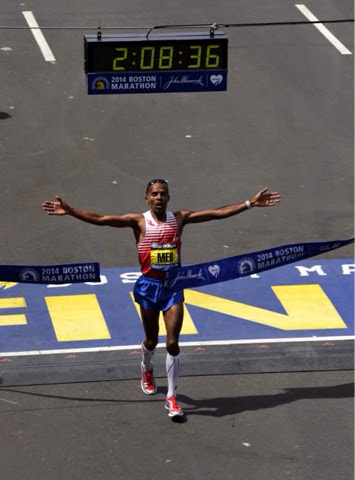
On my mind that weekend was the beautiful win by Meb Keflezighi at Boston. A year on from the unspeakable, the first American win since 1985, from a man who walked across an Eritrean desert at the age of 12 to escape a civil war. A perfect result.


Tuesday, 1 April 2014

Marathon training - end of part one

"One final time, I will do a 'time on feet' run rather than doing the prescribed distance," I told myself on the last sunday of March. 20k over 2 hours instead of the 24.5k on my plan. Fresh snow meant a lot of crashing foot falls, flailing about and swearing at the cold wind. January weather is bad enough in January, so I was more than happy to get it over with.

Monday's 10k easy run was also cold, but it wasn't snowing and the wind had backed off. My toes hurt - or rather the part at the top between the bridge and toes. Doubtless from sunday's ordeal of random crash landings. The hope is that this won't happen again until next winter, though I wouldn't bet on it. 

Tuesday was still rather chilly, but one more easy 10k with fewer rattles and squeaks than Monday. New shoes got their first outing, no drama there as I've been wearing Adidas Response Cushions for 3 years.
Tuesdays are also a core/ weights day, 2 circuits of 11 different exercises. I tend to feel it little lifeless after this, though after dinner all's good.

Wednesday was shorts time. What are shorts? I'd almost forgotten myself. I buy running shoes 2 pairs at a time, so this was time to start wearing in the second pair. 
This was my final speed run of my marathon training, next week will be the start of strength runs - long intervals at between half and full marathon pace. Today's speed finale was 3x 6 minute intervals at with 3 minute recovery in between. Target pace is under 4:00/ km. I slow down if my garmin says I'm going 3:45 pace which to my delight I had to do several times. 

Thursday is a core/ weights day and the only day without a run. My least favourite day, but there's a plan to follow. On the whole, the fact that I have to restrain myself works in my favour. There are few times when I have to talk myself into it, though on the March Sunday I had to crowbar myself out of the front door. 
There was also a visit to the chiropractor, as I've been doing every 3 weeks since February. Calves especially tight this time, probably from sunday's crash-bang session. That and high mileage led me getting the choice between 2 or 3 weeks. 2 it is. Easy decision really.

Friday: marathon pace run, and warm enough for shorts again. Just the occasional bit of ice under bridges. I did a small amount of exploring and carried on the north side of the river on a pathway that passes through the middle of Calgary Zoo. For the record, one moose, 5 turkeys, a snow monkey, and a plastic diplodocus.

Saturdays are for my take on the biathlon. I take the bus to the gym, only 5 minutes away. I do 10 minute warm-up on the rowing machine, followed by 3 circuits of my core workout routine. I then get changed into running gear with as much preparation having been done before my core workout (drinks, etc). I eat a couple of granola bars while getting ready. I then run home with a small backpack on. I either run 16k which is followed by another 16k on Sunday, or 13k followed by 26. My legs often stiffen in the last 3 or 4k, though in the past couple of weeks they've been recovering quicker and quicker. 

Sunday's 16k found me trying a new path over the river in Fish Creek Park, turning around just as I got to the hill up the other side of the valley. I just managed to keep ahead of a dark rain cloud and back home to noodles for lunch. 
12 hours a week rather than 8-9 is having an effect on my weight - thinking the scales were off in my work changing room, those at the gym also say I'm lighter than I'd usually be at peak week. That's a whole month early. Most of the extra hours are at "fat burning pace" and more efficient use of fat for fuel is what my plan is designed to do, so probably a good sign. Saturdays involve core workout then 13 or 16k run home. That 3+ hours on my feet is probably mostly responsible for my trousers getting loose.  There are good signs, but I'm not going to take anything for granted. 

Tuesday, 11 March 2014

Overcoming Injuries

Did someone say the I-word? Nearly every runner has had to deal with this unmentionable at some point.

So, once there, we're all thinking about how to recover to get back to running. What do you do, and where do you go?

The best 1st step is to see a sports injury specialist
I see a sports chiropractor myself. First of all, where the pain is isn't necessarily where the ultimate problem is. One example is ITB syndrome. While felt just above and at the top of the knee, it comes from the hips and glutes pulling upward. 
Once diagnosed and being treated, quiz your expert for exercises and stretches which help towards recovery. Injury usually shows up your body's weakest link, so continuing with such exercises post-recovery will also help in stopping the same injury return. 
Listen carefully for the recovery timeline. 2 weeks for a purely muscular issue is what I myself am commonly given. I've been going to the same chiropractor for nearly 10 years - since my overweight, pre-runner days in fact, which has the added benefit of him knowing my quirks particularly well.

The first instruction I'm given is not to run
Humbug. Non-impact cross training will keep general cardio fitness from dropping too much, though it could suffer just a little. The stationary bike is a common go-to machine. You can even replicate speed work on them, to a certain extent. 
Tip (& joke): if you've been on the bike for more than 30 minutes, cover your mouth when getting off to muffle the squaking yelp you will probably let out from sitting on the diamond-hard seats they tend to be fitted with. 
I've used the elliptical for cross training, but suitability can depend on the injury in question. If it doesn't feel right, switch to something like the bike. Swimming of course will be gentle on the joints. 

The 1st run back
You might have been itching to run again, I always am. However while away, many of us over-analyze what state we're in. If you're pain free and are within the timeframe you were told to start again, it's time to lace up. A 30 minute trial run if you're used to going an hour+. Take corners nice and gently, slow down a little for them. 
Ignore doubts and slight any "tightness" or niggles. Even when uninjured, there's often a random ache during warm-up. A left hip here, a right shin there. The point is to wait until after warm-up (give yourself 10-15 minutes) to truly assess what's going on unless experiencing actual pain. 
Go at an easy pace, but not slow enough to make it a jumpy walk which can be worse. 

Post-run assessment
How do you feel at the end of the run, a couple of hours later, and the next day? If all feels good the next day, then recovery has gone well. Aches and tightness a few hours after are ok, within reason. Each runner being a little different will learn these nuances over time, and can gauge how quickly to rejoin a prior training plan. 

Planning for prevention
Long term, body and joints strengthen and become more resistant. An enthusiastic beginner should keep in mind that the goal should be to have a high annual average mileage rather than monthly. Over the years this will reap benefits especially when it comes to marathons. Increase mileage by spreading it out more - run on more days rather than making individual runs longer. Weight training has its place, especially free weights which enhance core strength, balancing and stability. 
Each injury, as with each race is a chance to improve. Research, analysis and advice from what went wrong - or right - should lead to an improved and more suitable training plan which in turn makes a runner both healthier and more potent on race day.

Sunday, 16 February 2014

Marathon training starts

Here begineth the odyssey to the June 1 marathon. I might have to be a little cautious to start off with because of the half marathon just gone. 
Wednesdays will be speed work - 5k pace intervals - for February and March. For April and May, "strength runs" take over. These are one long continuous run at between half and full marathon pace, around 4:20/ km in my case. The plans for the speed runs are tough to remember in your head (1.5 minutes with 2 minute recovery for example), so I bring a note with me.
Friday was my first ever marathon pace training run. Amazing to think that all this time, with 3 marathons behind me, I'd never done one till last week.
Saturday called for a 10k easy run. On that day I usually do core work at the gym. I didn't want a run to replace weights and balance training, so I took the bus to the gym and did my strength work, then ran home. When it's extra cold weather, this could mean carrying quite a bit with me, although running with a backpack does generate extra heat. 
By now I have quite a range of clothing options to make it all doable no matter what the weather. After 2 hours of squats, lunges, single leg dead lifts, etc. my legs felt rather lifeless on the run. I felt them stiffen a bit, so dialling back the pace to what I reckon was mostly fat burning, they started to recover. I reckon more glycogen had cycled into them by the end, as I ended up running more comfortably at a faster pace.
I was greatful for the butter chicken, quinoa salad and Turkish bread once I got home. 
Sunday was windy, with gusts up to 60 kph. At times I could only exhale looking over my shoulder. The last k (of 16) was straight into the wind, and walking was just as good a workout. 
Hamstrings felt tight, and I wondered if I'd be ok for family day's 10 k easy run. Nice and gently does it, I told myself. Legs gradually loosened, and felt slightly better even for Tuesday's identical 10k. That is normally a weights day, so I did that in my basement at home. Another first. Now that I've changed my weight routine, all I need is a mat, a kettlebell and a pair of dumbbells. 
Wednesday was speed work, into a strong wind for part of it. Experience counts here, knowing what effort to put in when a gale stops you from reaching target pace. 
So there it is, my first ever 6 days in a row of running. Every week until June 1 is going to be like this. Good posture, smooth technique, being mindful of what condition I'm in and visits to the chiropractor every 3 weeks ("State of the Legs address") are the order of the day every day for the 100 or so days. Onward with my most focused training ever.

Monday, 10 February 2014

Hypothermic Half in all its glory

Last year's St Patrick's race took place in almost blizzard weather. That however was a 5k. 22 minutes and I was done, and I won a beer glass for getting top 3 in my age group.
This is a half marathon. -16, and a breeze that in places made for a windchill of below -20. Mostly though it was the overnight thin layer of snow that would slow everyone down. No good purchase on the pathways. 
My first Hypothermic Half, it starts at Fort Calgary, the very origin of the city. It started off slower than I expected, and within a minute my toes felt frozen. Well ventilated shoes really let that air in. 
Distracting from that was the sight of a guy doing push-ups next to the river. He didn't even clear the snow off first. 
At Prince's Island, a very tall guy surged in front of everyone. I went with him, and soon saw my watch reading 4:08/ km. Let him disappear at this unsustainable pace, I thought. Once over the river, the gradient is a bit steeper, the snow a little deeper and the wind faster as well as more head-on. 
The leader had turned around to confirm he was going in the right direction. I gave a big thumbs-up, easily visible with black mittens on (gloves underneath). Up to the turnaround 2k later, I coughed almost continuously. I lost count of the number of times I had to spit.
The turnaround was at 9 k, with the way back following the path north of the river. The lead guy stopped for a drink there too. I had my own, and kept the bottles in my pockets to prevent freezing.
I found myself now in the lead. It meant a lot of encouragement from other runners coming the other way. High fives, and even a honking freight train on the opposite river bank got me a little carried away on pace. I might have even extended my lead for a couple of k. 
Even a lady waving to a friend who nearly clothelined me was exhilarating. 
By 13k, I'd slowed myself down enough to be joined by the tall guy, Nick. 1:28 pace was not going to end well, so restraint was best. Nick wanted to break 1:30 he said. "Not today" we agreed. 
When would he overtake? I mentioned that a win would be good, but I had nothing left. It was my hint that he'd get no contest for 1st when he sped up, which he did at 17k. 
Thinking about this race's place in my marathon training, I was on a gradual controlled slowdown into the finish.
The bridge near the zoo is a nice scenic spot with some stretches of solid ice.
I noticed another guy catching me, and actually gave myself the aim of being overtaken. Without that I would have engaged in an over-the-top finishing splurge. Not today, with half of a half marathon training program behind me, and on my way to a marathon aim that has eluded me for 2 years.
I spotted my wife before finishing in 1 hour 35 minutes for 3rd place. I skidded to a stop before saluting the guy handing out the medals.
The brunch at the Fort (what a great movie title that would make) was just what a runner needs.
A fairly good performance overall. A sub-90 if the paths had been clear. Overcoming tough conditions has its own reward, similar but distinct from getting a PB. Onto the marathon project. 
Here's the link to my race vid: http://youtu.be/LF_HzKxqk9I

Monday, 27 January 2014

January check-up and a car full of hecklers

Mid-late January has spoiled Calgary runners with some shorts weather, though this isn't a January first. 

A good respite from the severity of the weather before. Downtown, one could get good purchase on clear and dry pathways. There were some major exceptions, where shade means melt water doesn't drain away enough before re-freezing. West of 14 street the guardrail leaves lines of ice like stripes on a zebra.
Worst of all is the state of Fish Creek Park pathways and its polished snow and the pavements to get there. There's so much piled up that there won't be much respite for my long runs until it's all melted in April-ISH. I've taken to the road a few times. 
After the first 2k it gets better on the way to FC Park. Once there, the access road and path around Sikome lake provide a good running surface, though to get in 20k means seeing this same route 3 times in one run. Along with fatigue, cold and everything else, this is all part of training.
Even hecklers come into the mix. While taking in that access road, a car (guessing it was a 1995 Pontiac Grand Prix) full of potheads pulled up along side. All they could do was yell "go!" A couple of times. Useless bored kids with nothing to do (duh, take up running!), I figured they'd last a few seconds before tiring of me too. They did. When they came back the other way, I crossed the road. 

Overall, training's been good. I started halfway through a half marathon program in December to lead into the hypothermic half then marathon training. Just to be sure of not over-stretching, I have cut interval runs slightly short by a minute or two.

Having done hot yoga last year - too sweaty and better for those who exercise less than I do- I tried "cold" yoga for a couple of months. Now I have the basics, I'm going to do a couple of yoga for runners routines I found online (here's a good one: http://youtu.be/_IlzyuRQwsc) at home from now on. 
Head stands are tough, and more importantly not contributing to improving my running. There's also something about some yoga classes that isn't for me. Actually praying ("ooohhhmmmm, shanti, shanti," etc.) at the start, and putting one's hands together and wishing "namaste" to everyone in the room seems contrived and false. 

One place I'm always going to go to is the chiropractor. The same doctor has been treating me since before I was a runner - just a fat guy with a bad back. These days he irons out tight spots, some of which I'm not aware of. My right foot is about half a size smaller than my left, as well as my right leg being slightly shorter than my left leg. The inevitable imbalance needs regular attention to enable a higher training load. I often ask questions on anatomy, muscle function, etc., making trips to the chiropractor beneficial in 2 ways. 

The Hypothermic Half is now just around the corner. Aim for that race depend on conditions on the day. There are 2 starts, mine is at 1pm. An afternoon race is another first. If conditions allow, I'll try for just under 1:30. I won't go any quicker unless there's somehow a chance of winning - previous years' times have had 1st place coming in just under 90 minutes. 

Wednesday, 8 January 2014

Hanson's Marathon Method (& my plan)

The marathon, for me, has been in some ways frustrating. My PBs in other distances indicate that I should be capable of 3:05 or quicker. Yet in 2012, when I attempted to clock 3:10, I had to stop to stretch seized hamstrings 4 times after 29 km. 
A matter of more kms a week? Probably, however I can be quite injury prone, especially when I race too much. Refining my weight training and smarter race scheduling aside, I need to find a way to smartly add more kms without bringing on injury. The Hanson Method may be the answer. I will find out for sure on June 1. 

The general thinking is that too much emphasis is put on the Sunday long run. Too great a distance on that day takes too much out of the body, reducing the quality and training effect of other runs. It believes in the concept of "cumulative fatigue", while rejecting that of "junk miles". 
There are 6 runs per week, 3 of which are at easy pace. The longest run is 26km. 2 of the runs are higher paced, one at marathon target pace (instead of current 5-10 minute intervals I currently do). The other starts off with speed intervals (varying lengths at 5-10k race pace), giving way to long strength intervals between half and full marathon pace (in my case, 4:15-4:20/km). 

I have made a few key changes. The rest day is on Thursday instead of Wednesday for a couple of reasons, including wanting the day after the speed/ strength days to be a rest day (which means gym and yoga in my case). I have also put the intervals in minutes rather than distance. Remembering what distance my watch read constantly is difficult during hard running, a round number in minutes works better. Not having a track to run on and the possibility of a gps watch not working also figure. For these reasons, I have "converted" the distances into time blocks based on target pace.


The plan is meant to start a couple of weeks earlier than it actually does, however I'll be doing the Hypothermic Half on February 8. 
No more races until the marathon after that - I can never stop myself from going full speed, so not racing is the only way to solve that problem. 
I did a 5 and a 10k in the 2 months before the 2012 marathon - the joy of those 2 performances (19:25 & 39:23 respectively) was tempered by affecting my training and by those 2 races themselves taking the place of training runs. 
This marathon has involved a lot of analysis given past races (I'll admit to a lingering fear of the 42.2), so it's just one race nearly 4 months prior, new weight routine and the Hanson Method.